NSW Automatic Meteor Detection System
Overview,Software - Cameras - Fireballs - Meteor Showers - Links
2nd Mar 2004 12:38:39 UT Peak Brightness -4.9 mag
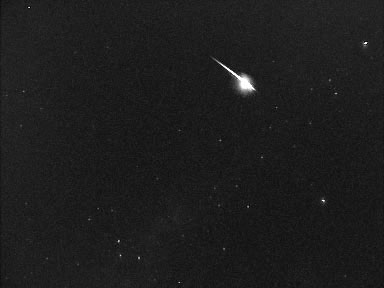
18th March 2004 13:06:39 UT Peak Brightness -4.0 mag

A choice Northern Taurid. 13 Nov 2004 12:28:47 UT Shows a 20 degree trail and a beautiful terminal flash (approx -5.0 mag).

A very bright meteor recorded on 9th May 2005 at 18:52:20 UT peaking at -5.5 magnitude.

Getting brighter. Recorded 20th
May 2005 at 14:07:48 UT This one peaked at -6.6 magnitude.
*The 12 day old moon (nearly full) is just outside the field to the
upper right and is the source of the internal lens reflections
diagonally across the frame.
The pointers and southern cross are below it in the bottom right
quadrant.
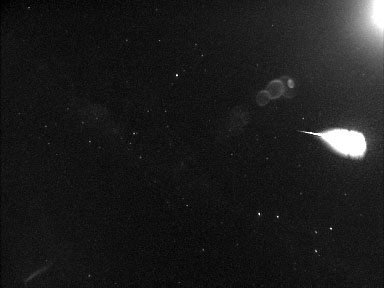
Whoa! They just keep coming. This one was -6.0 magnitude at the terminal flash. Recorded 04th June 2005 at 16:32:07 UT
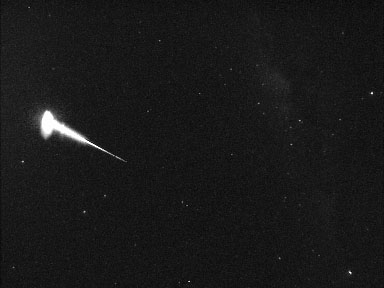
This meteor was recorded with
the 2 camera system on 9th May 2006.
A bright moon is at the top of the north facing camera field. It was
nearly 100 degrees long and peaked at around magnitude -5.
The gaps are where the computer dropped video frames.
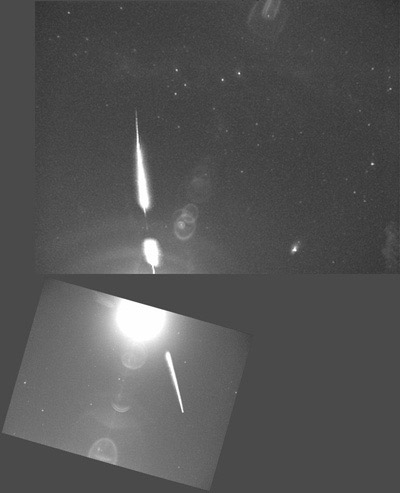
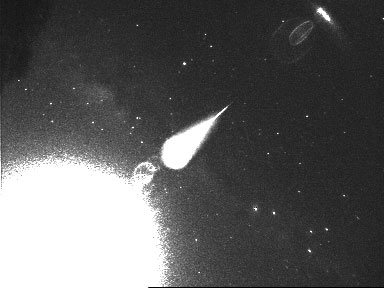
The biggest one recorded by the cameras at Mudgee. 2010 April 12th
On the night of 12th April 2010
during an imaging session in my observatory, I was startled when the
whole place lit up like daylight.
The overhead meteor camera caught most of this fireball heading south
down past the tail of Scorpius but dropped a lot of frames during the
central part. The software gave a peak magnitude of -5.3 at the end of
the first section (center of frame) but the system was clearly saturated
after that.
It would have been many times brighter than that, as shown by the huge
flash near the end (lower left corner).
This fireball was also witnessed by several observers at an annual
star party held at
Mudgee
Observatory , who also said it lit everything up like day.
Often, bright meteors end with a bright terminal flash but meteors can also 'pop' as different materials disintegrate.
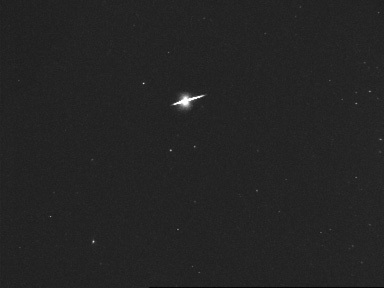
On rarer occasions you see one do a double pop.
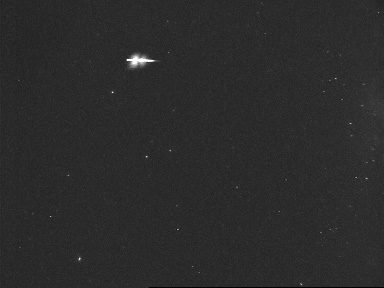
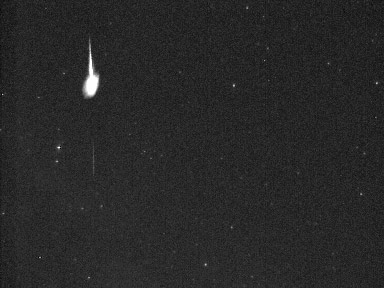
WooHoo... a big triple banger
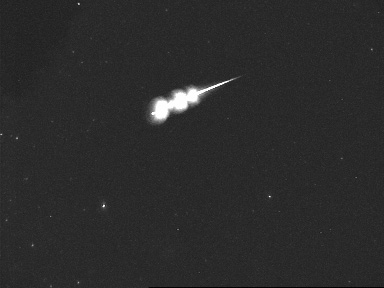
On 25th Aug 2011 at 14:22:39 UT
two particles in the same orbit entering the atmosphere at the same
time.
The meteor at top peaking in brightness at -3.2. This is quite rare to
see two on the same path.
Lightning Sprites
A happy consequence of monitoring meteors is that other interesting things are also recorded.
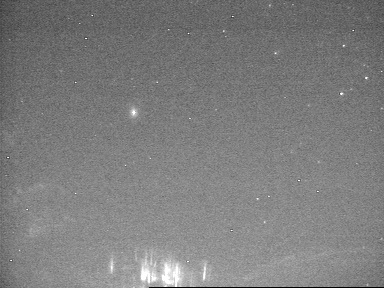
All sorts of things show up in the cameras... flying foxes, possums, micro bats, frogs, spiders and bugs but the coolest is Sprites from lightning.
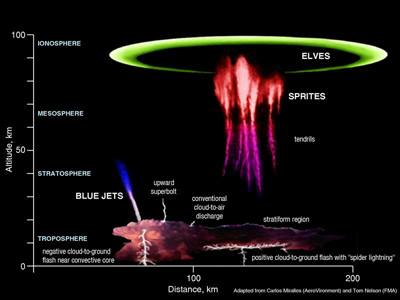
Sprites are electric discharges
that extend from 50 - 90 kilometers above thunderstorms triggered by
lightning.
They occur in the upper atmospheric regions of the Stratosphere and
Mesosphere and reach almost to the edge of space.
Diagram from Wikimedia Commons
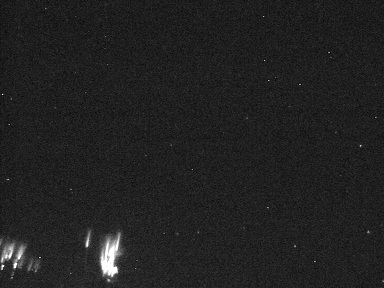
The first set captured here
appear to be from a storm somewhere along a bearing running from Mudgee
to half way between Nyngan and Coonamble.
A rough estimate puts the lightning in an area near Warren NSW, around
150 kilometers away from here.
The Sprites last only a fraction of a second and I did not expect them
to be so bright in the meteor cameras. see WIKI page
Captured on the night of 22nd
October 2014 at 13:00 and 13:51UT.
The cameras face toward the NNW from Mudgee.
Field of View of camera with 6mm lens is 55 x 40 degrees.
Bottom of the FOV is around 24 degrees altitude.
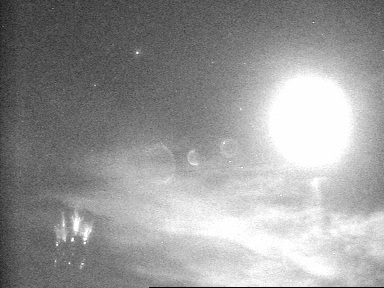
Another capture of Sprites from
the west facing camera on 27th November 2017 at 12:20:35 and 12:33:56UT.
There was also some cloud and a bright Moon in the field of view.
Top - Return to Frog Rock Observatory